

I am coaching a leader in one of the most technologically advanced industries in the world. Their company is building products that didn't exist a few years ago, in an environment where the technology is evolving faster than they can learn it.
When we first started our coaching together, he was experiencing overwhelm and stress and was on the verge of burnout. He was leading a team of young engineers, all freshly out of college, and he was convinced that he was the only one with all the answers.
So what did his team do?
They went to him for all the answers.
In fact, there was very little they did without his involvement.
He had made himself the bottleneck.

What Happens When You Stop Giving Answers
Many new leaders I work with often find it difficult not to give answers when their people come to them, but that is exactly what leaders need to do if they want to:
Build capacity on their team
Allow their young team to learn and grow, hence allowing for organizational learning
Reduce leader overwhelm
So how do you ensure your team has the answers they need to do their job while also giving them opportunities to learn and grow?
Let me answer that with a story.
Many years ago, I was working with the general manager of a manufacturing company. Reporting to him was the Director of Sales. One day, this director quit, leaving the entire company sales team with no one to turn to for answers.
So who did they turn to? The next person up – which was my client.
Suddenly, he found himself barraged with people in his office all day long. He could barely get any work done because he spent his entire day telling people what to do.
I knew he had to find another way. So I made a suggestion.
When people come into his office for answers, he is to stop and ask them to come up with three ways they think they could solve their own problems.
If they had no idea, they had to guess or think about it – perhaps ask others on the team or reference a manual.
The rule was: when you went into the general manager’s office, you had to be ready to share 3 ways you could solve your own problem before he would even talk to you.

The general manager decided he would give this a try.
At first, the salespeople were confused. How were they supposed to come up with answers about things they knew nothing about? But the general manager assured them that even wild guesses were okay.
Each time someone came into his office, they would present each situation and how they thought they could go about solving the problem. As he listened to each approach, he would share the pros and cons of each solution. Through this process, they learned more about his thought process, the resources he consulted and the experts he turned to.
He wasn’t just giving them answers – he was teaching them how to problem solve.
He didn’t just abandon them to find their own solutions; he did it in a way that made them feel guided and supported.
And do you know what happened?
After 30 days, no one came into his office anymore.
Not one person.
Why?
Not only did they learn how to solve their own problems, they grew in their own confidence that they could solve their own problems. That’s important.
If people don’t feel confident in their problem-solving abilities, they will always doubt if they can do it and they will hesitate. They will want to be validated.
But that didn’t happen here.
Not only did this general manager increase the capacity of his team, he also freed up his time to focus on the strategic direction of the entire organization.
So this is one way to build active daily learning into everyday task accomplishment at your organization.
Here is another way to build capacity in your organization…
Effective Delegation
When people hear the word delegation, they often think it means handing work to someone else. I have seen two ends of the spectrum:

Some leaders hold onto everything. They can’t let it go, so they do it themselves, or they need to be fully involved every step of the way.
Or…
They hand work off with little clarity, little oversight, and little support. Then they are surprised and upset when things go wrong, making them hesitant to let anything go again. All while complaining that they don’t have enough time in the day to get their work done.
When I listen to my coaching clients, often they are spending significant amounts of time making decisions that other people could be making.
Not because they want to be controlling. Usually, it’s because they want things done well, and they are afraid the person might make a mistake.
The problem is that every decision they keep becomes a decision their team never learns to make.
Let me say that another way:
When you keep every decision, you deny your team the opportunity to learn a new skill or capability.
When the year is over, they are not much farther ahead in their capacity, and the team stays stagnant – always relying on the boss to continue to do all the work.
The leader becomes increasingly overwhelmed while the team becomes increasingly dependent.
And how about organizational learning? Also at a standstill.
Nobody wins.
Not Everything Should Be Delegated
This is where I find Leila Hormozi's delegation model helpful.
She suggests that leaders evaluate work using two questions:
“How important is this decision?”
And
“How much expertise or competence does it require?”
Those two questions create four different quadrants.
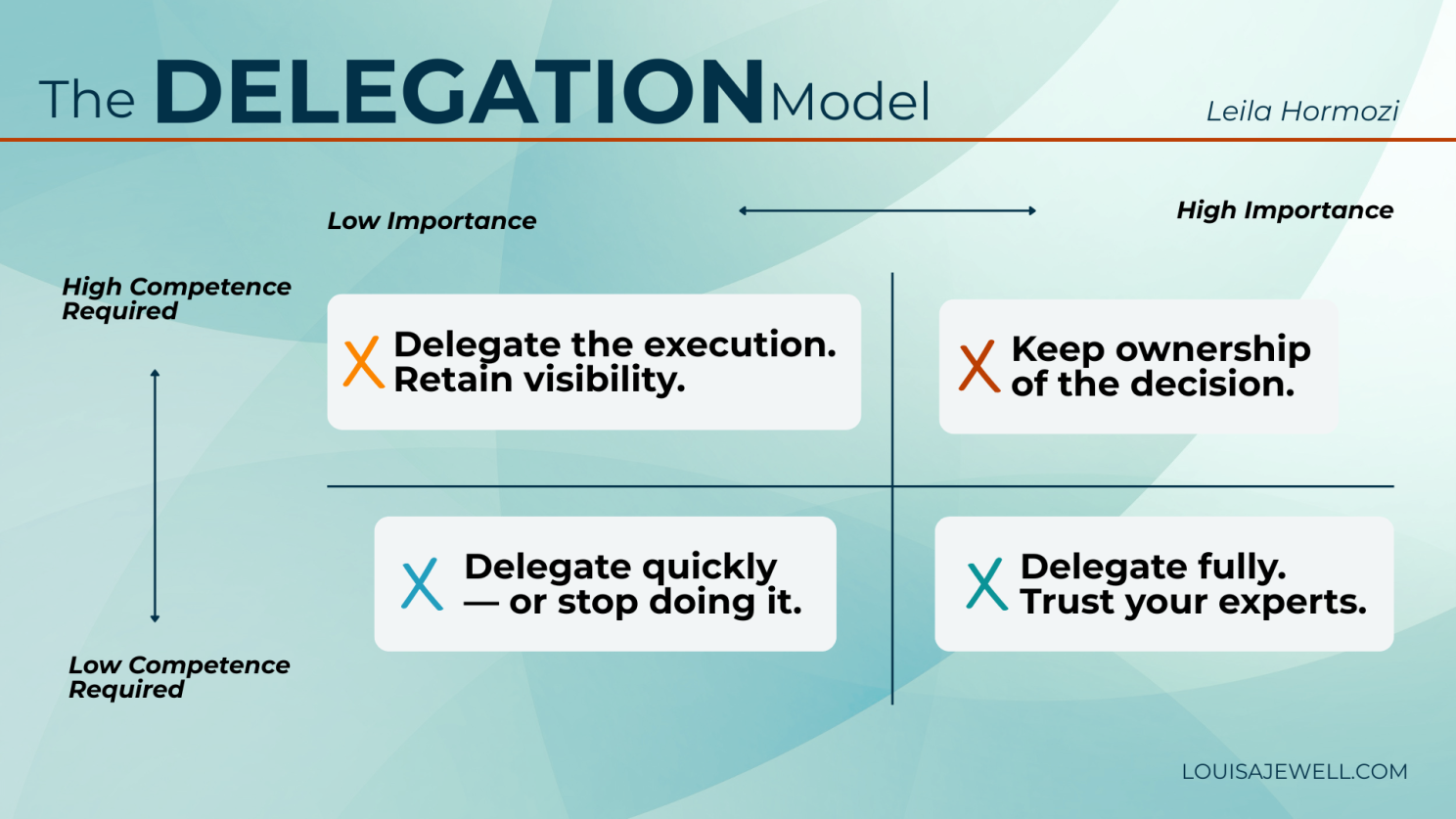
1. The task has Low Importance + requires Low Competence
In this case, delegate it quickly or stop doing it altogether. Leaders waste enormous amounts of time on work that creates very little value.
2. Low Importance + requires High Competence
Delegate it fully and just have the person check back to ensure it’s done. I think of non-important updates to my website – they have to be done, but my business will not crumble if it doesn’t get done right away.
Here, I trust my experts. Micromanaging skilled people is one of the fastest ways to slow an organization down.
3. High Importance + requires Low Competence
Think: Safety inspections. They are incredibly important, and the consequences can be significant. Most inspections follow established procedures, checklists, and standards that can be performed by competent members of the team.
As the leader, you don't have to conduct the inspections, but you might review completion rates each week, discuss any issues that were identified, and ensure that follow-up actions are on track. In other words, delegate the execution but retain visibility.
This is where many leaders get stuck.
They assume that because something is important, they should be the one doing it. The better leadership move is to allow someone else to do the work while creating the right checkpoints to ensure nothing critical slips through the cracks.
4. High Importance + High Expertise
Here, you will want to keep ownership of the decision. Think of important company negotiations with major partners. This could make or break your business. Others can provide input and eventually execute, but some decisions require senior judgment and carry consequences that are difficult to reverse.
I love this model because it is easy and practical.
A Question to Ask Yourself Regularly

The goal is not simply to get work off your plate.
The goal is to build decision-making capacity on your team.
If your team never makes decisions, they never develop the judgment required to take on more work. If they never develop judgment, they never become leaders.
Creating the conditions where capable people can actually learn and grow builds capacity.

The leaders I work with don't just want to get things off their plate. They want to build teams that can think, decide, and act without them.
If that is where you want to go, I would love to help you get there.